Funding the Future of Mining Technology: From Investment to Industry Adoption
The mining industry needs innovation to meet future demand for critical minerals. Yet developing a promising technology and
Read article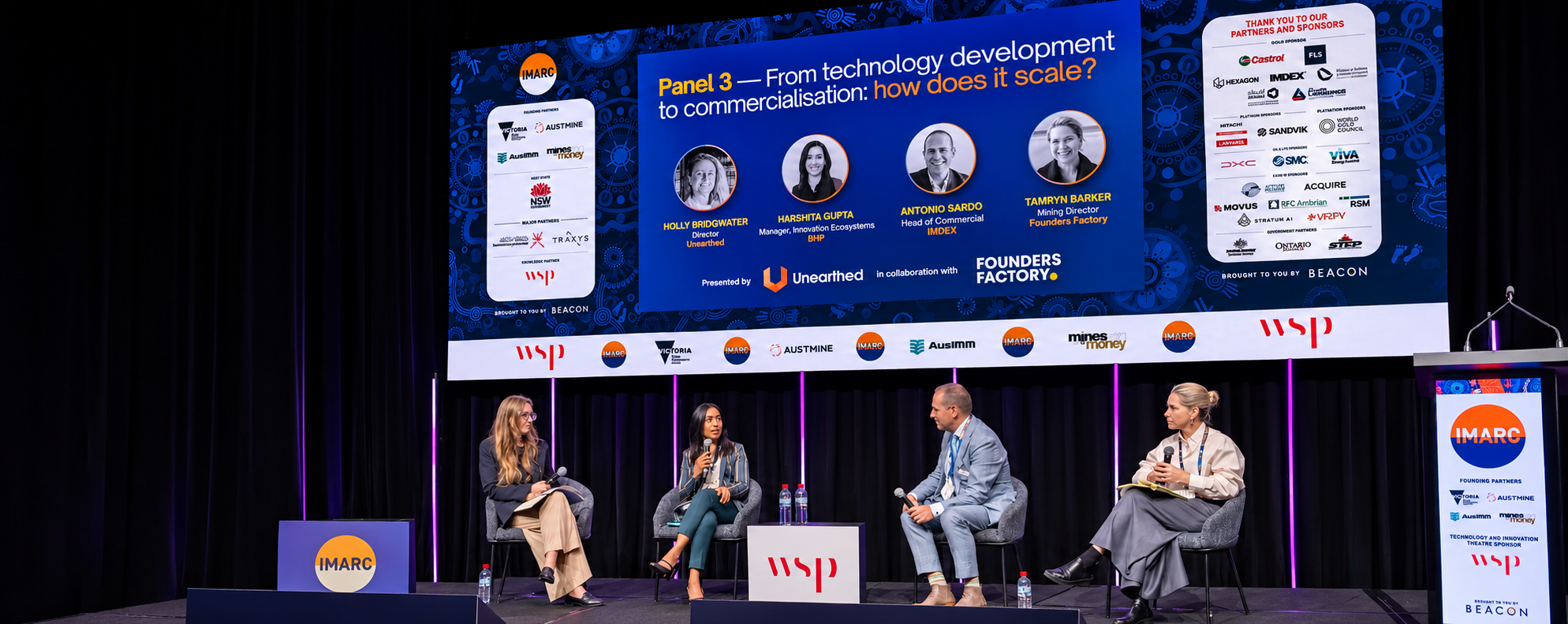
At IMARC 2026, Unearthed and Founders Factory brought together investors, mining companies, founders and technology leaders for Funding the Future of Mining Tech, a series of three panel discussions moderated by Holly Bridgwater, Director at Unearthed.
The session brought different perspectives to three interconnected questions: Where are the gaps in financing mining technology? Which technologies should the industry prioritise, and who should carry the risk of developing them? And what does it take to turn promising solutions into commercially deployed technologies?
Together, these themes point to a broader challenge: the industry needs more than capital to accelerate innovation. It needs clearer pathways connecting technology development, investment and operational adoption.
The first panel, Is There a Capital Gap in Mining Technology, and Where to Crowd In?, brought together Sarah McDougall from the National Reconstruction Fund, Mark Frayman from Orion Industrial Ventures and Steven Vassiloudis, CEO of Novalith Technologies.
While substantial investment is being directed towards critical minerals and industrial development, technology companies can still face significant difficulties securing the funding needed to move from early validation to commercial-scale operations.
The challenge is particularly pronounced for capital-intensive technologies.
Early-stage investment can support research, development and initial demonstrations. At the other end of the spectrum, established projects with predictable revenues and proven operating performance may be able to access traditional project finance.
But between those stages sits a difficult funding gap.
For a technology developer moving towards its first commercial facility, capital requirements can increase from tens of millions to hundreds of millions of dollars, often before the company has the operating history or commercial commitments needed to attract conventional lenders.
First-of-a-kind projects can carry risks more commonly associated with equity investment, while their potential returns may not meet the expectations of investors prepared to accept that level of uncertainty. Traditional project finance can also be difficult to secure without established performance and customer commitments.
For founders, relying entirely on equity to finance commercial development can result in substantial dilution. For investors, the scale and complexity of the project may sit outside their preferred investment mandate.
One potential pathway is to bring together different sources of capital, with each contributing according to its ability to manage risk.
Government-backed investment, private capital, strategic investors and customers can all play complementary roles.
The National Reconstruction Fund, for example, is designed to fill financing gaps for Australian businesses to help them scale up, modernise, and move up the value chain.
However, filling a financial gap is not necessarily the same as addressing the reasons that gap exists.
Independent engineering studies, third-party validation, credible customer commitments and experienced project development teams can help reduce uncertainty and strengthen the case for investment.
For technology companies, this also highlights the importance of structuring capital raises around specific development milestones and the risks being addressed at each stage.
Rather than viewing commercialisation as one large funding hurdle, a more effective approach may involve progressively demonstrating technical feasibility, operational performance, commercial demand and project readiness.
The opportunity is not simply to make more capital available, but to create the conditions that allow investors to support technologies as they move towards commercial scale.
If capital is limited, another important question emerges: where should it go?
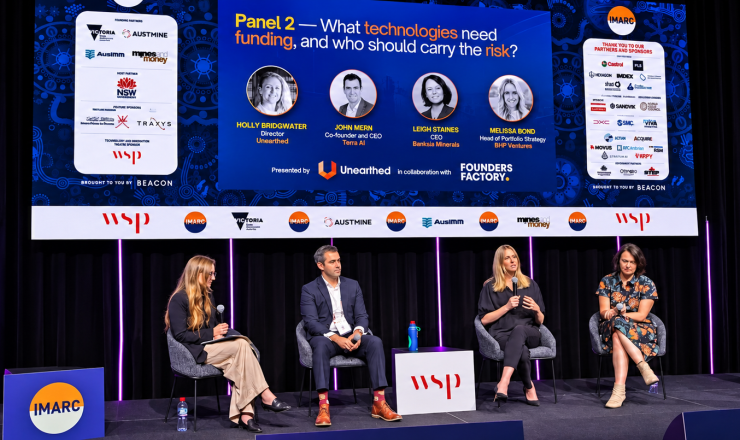
The second panel, What Technologies Need Funding, and Who Should Carry the Risk?, brought together John Mern, Co-founder and CEO of Terra AI; Leigh Staines, CEO of Banksia Minerals; and Melissa Bond, Head of Portfolio Strategy at BHP Ventures.
Their perspectives span mineral discovery, processing innovation and strategic technology investment, highlighting the different opportunities and development challenges across the mining value chain.
Future mineral supply will depend on advances across exploration, extraction and processing.
In exploration, new technologies have the potential to improve how mineral deposits are identified and assessed, helping the industry respond to the challenge of discovering resources that are increasingly difficult to locate and develop.
However, it’s important to make a distinction: the technologies with the greatest potential industry impact are not necessarily those that are easiest to finance.
Software solutions can often be developed and tested with comparatively modest capital. Physical technologies, particularly those involving new processing systems, may require specialised facilities, extensive validation and substantially greater investment before they can generate commercial returns.
Yet those more difficult development pathways may be essential to addressing some of the industry's most significant challenges.
For a major mining company, technology investment is not evaluated solely through the lens of financial returns.
Operational priorities vary between assets, and the technologies needed to address one operation's challenges may be very different from those required elsewhere.
This raises a broader question for the industry.
How should investment decisions account for technologies that could deliver significant operational or strategic benefits, but require longer development timelines or higher levels of early-stage capital?
A purely financial investment model may not always capture the potential value of technologies that could unlock new mineral resources, improve processing economics or address challenges shared across multiple mining operations.
The question of investment priorities is closely connected to how development risk is shared.
Founders and venture investors can play important roles in supporting early innovation, but capital-intensive technologies often need access to capabilities that extend well beyond funding.
Mining companies can contribute operational expertise, commercial validation and opportunities for pilot deployments. OEMs can support engineering and integration. Government funding and investment may help address gaps in capital or validation infrastructure.
However, access to the right people and operating environments can be just as important as financial support.
Technology developers may struggle to secure suitable pilot sites or testing facilities, while mining companies face legitimate constraints around production risk, safety and operational disruption.
Greater collaboration between operators, investors, technology developers and government could help reduce duplication and distribute development costs, particularly where technologies address challenges shared across the industry.
There is also the question of time.
A technology with a credible five-year pathway to deployment presents a very different investment proposition from one that may take 10 to 20 years to commercialise.
Earlier engagement between researchers, OEMs, mining companies and investors could help identify commercial and operational requirements sooner, reducing the delays that arise when each stage of development is approached independently.
Ultimately, deciding which technologies deserve support is only the beginning.
The more difficult question is how to build funding and development models capable of supporting the technologies the industry considers essential, even when they fall outside conventional investment expectations.
Even when a technology attracts investment and demonstrates technical potential, deploying it successfully within a mining operation presents another set of challenges.
The final panel, From Technology Development to Commercialisation: How Does It Scale?, brought together Harshita Gupta, Manager Innovation Ecosystems at BHP; Antonio Sardo, Head of Commercial – Exploration and Production at IMDEX; and Tamryn Barker, Mining Director at Founders Factory.
The discussion themes moved beyond funding to consider the practical realities of commercialisation, including customer engagement, operational integration, partnerships and the capabilities required to scale.
A central distinction is that a successful pilot demonstrates technical feasibility, but not necessarily commercial demand.
A technology may work exactly as intended without having a clear purchasing pathway, an identified operational budget or a compelling enough business case to justify broader deployment.
Large mining companies can provide technology developers with access to operational expertise, technical context, data and opportunities for validation.
But supporting the commercialisation of new technologies is not their primary business.
Mining operations are designed around delivering production safely and reliably. Established mine plans, lengthy planning cycles and complex approval processes can make it difficult to introduce emerging technologies, particularly when those technologies have not yet been demonstrated in comparable environments.
For a large mining company, supporting commercialisation does not necessarily mean becoming responsible for taking a technology all the way to market.
Instead, the value it contributes may lie in helping founders understand the operational environment, providing technical expertise, supporting early demonstrations and creating connections with organisations better positioned to assist with subsequent development.
This creates opportunities for new partnership models.
Rather than relying on one mining company to fund and validate every stage, founders could benefit from collaboration involving multiple operators, venture builders and OEMs.
Early involvement from equipment manufacturers can be particularly valuable when emerging technologies need to integrate with existing equipment and operating systems.
It also raises an important question about how mining companies assess risk.
While introducing a new technology can create operational uncertainty, delaying adoption may also have consequences through missed productivity improvements, higher costs or slower progress towards strategic objectives.
The risk of trying something new needs to be considered alongside the opportunity cost of maintaining the status quo.
For founders, commercialisation cannot simply begin once the technology has been developed.
One challenge is the tendency to approach commercialisation sequentially.
A startup completes an initial test, seeks another customer engagement, refines its offering and begins a new round of technical or commercial validation.
In an industry where each engagement can involve lengthy approvals and different operational requirements, this process can significantly extend development timelines.
Running commercial conversations in parallel, keeping initial engagements focused and maintaining close alignment between technology developers and potential customers may help reduce these delays.
It is also important to recognise the full cost of adoption.
For a mining company, the cost of introducing a technology extends beyond its purchase price. Integration, technical support, maintenance, training and operational disruption can all influence the decision to proceed.
For founders, understanding these requirements early can make the difference between a promising demonstration and a viable commercial offering.
Choosing the right first customer is another important consideration.
While major mining companies can provide valuable expertise and credibility, smaller operators may sometimes offer more accessible pathways to initial deployment.
Founders also need to balance responding to customer requirements with maintaining a scalable product strategy.
Developing a solution too closely around one customer's needs can create a risk of becoming a bespoke service provider rather than building a technology with broader market potential.
From the perspective of an established mining technology company, successful commercialisation requires a clear understanding of the market.
Key questions include who will pay for a solution, which budget it will come from and what measurable operational improvement it will deliver.
Voice-of-customer research can help distinguish needs shared across multiple mining operations from requirements specific to individual customers.
This is particularly important when deciding whether to develop technology internally, pursue a partnership, share development costs with customers or acquire an emerging business.
Commercial potential also depends on how a technology fits within existing systems and workflows.
A solution may deliver strong technical results but still face barriers if it cannot integrate effectively with equipment, software, data systems or operational processes.
Gaining acceptance across multiple functions, from technical specialists to operational and commercial decision-makers, is often essential.
These considerations reinforce a broader lesson: technology readiness is only one part of commercial readiness.
Successful commercialisation requires technical performance, clear customer demand, operational integration and a viable business model to come together.
Across the three panels, several themes provide a useful framework for considering how the industry could strengthen its approach to funding and commercialising innovation.
Some of the technologies with the greatest potential to address future mineral supply challenges may also be the most capital-intensive and difficult to commercialise.
Investment strategies need to consider long-term operational and strategic value alongside conventional financial returns.
Technical validation, engineering studies, commercial demand and operational readiness all influence whether a technology can attract investment.
Understanding which risks are preventing progress, and who is best placed to address them, can create more effective funding pathways.
Access to operational expertise, decision-makers and testing environments can help founders develop solutions that address genuine market needs.
Early engagement can also clarify purchasing requirements and the practical steps needed to move from demonstration to deployment.
Mining companies, investors, government, OEMs and venture builders bring different capabilities.
More collaborative approaches could help reduce duplication, share development costs and support technologies through stages that no single organisation is well positioned to manage alone.
Completing a successful demonstration is an important milestone, but it is not the end goal.
Commercialisation ultimately requires paying customers, measurable operational value and a credible pathway to repeatable deployment.
The mining industry has no shortage of complex challenges, and there is a growing community of founders developing technologies to address them.
But the pathway from a promising solution to widespread industry adoption remains difficult.
Funding gaps, investment priorities, operational risk and commercialisation barriers are closely connected. Addressing one without considering the others is unlikely to deliver the progress the industry needs.
The opportunity is to create stronger connections between the organisations developing new technologies, the investors supporting their growth and the mining companies that can ultimately benefit from their adoption.
For technology developers, that means understanding industry needs, building commercial relationships early and demonstrating value beyond technical performance.
For mining companies, it means finding practical ways to engage with emerging technologies, support validation and create pathways towards deployment.
For investors and other industry partners, it means recognising where their capital, expertise and networks can help reduce risk and accelerate progress.
At Unearthed, we see the importance of these connections through our work identifying emerging technologies, understanding operational challenges and bringing founders together with the people and organisations that can help move solutions forward.
Whether through market intelligence, technology assessment or direct industry engagement, creating better connections between innovation and operational needs is an important part of building a more effective mining technology ecosystem.
The challenge is not simply finding the next promising technology. It is creating the right conditions for that technology to be funded, developed and adopted where it can deliver meaningful impact.
Thank you to Founders Factory for their collaboration, to IMARC for hosting us and trusting us again this year and of course to our nine panellists for contributing their perspectives and being part of this year’s event.
The mining industry needs innovation to meet future demand for critical minerals. Yet developing a promising technology and
Read article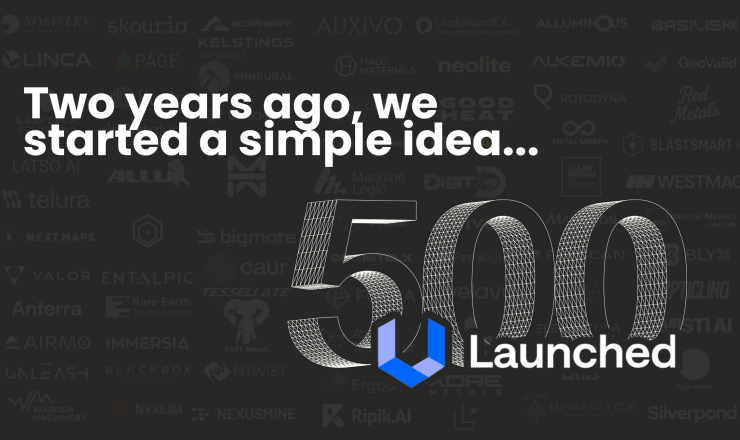
Two years of weekly profiles. When we started Launched, the idea was simple: feature 5 mining technology companies every week
Read article
For the past two years, Unearthed’s Launched feature has put emerging innovators on the radar of the mining and resources sector
Read article
For the past two years, Unearthed’s Launched feature has put emerging innovators on the radar of the mining and resources sector
Read article